> ## Documentation Index
> Fetch the complete documentation index at: https://mcpjam-mintlify-docs-update-pr-3305-1784516603326.mintlify.site/llms.txt
> Use this file to discover all available pages before exploring further.
# MCP protocol versions
> Pin the inspector to a specific MCP protocol version — including the 2026-07-28 stateless RC — to test how your server behaves across versions.
The inspector can speak more than one version of the MCP protocol. By default it negotiates whatever the SDK considers current, but you can pin a different version when you want to test how your server behaves against a specific draft — including the new **2026-07-28 stateless RC**.
This page covers how to pick a version. Automatic per-server version detection is on the roadmap; for now you tell the inspector which version to use.
**Migration required if you used the old Draft version.** The previous `DRAFT-2026-v1` placeholder has been retired and replaced with the upstream RC literal `2026-07-28`. If you had any servers pinned to `DRAFT-2026-v1`, you must re-select the protocol version in the inspector UI. Stored `DRAFT-2026-v1` pins are rejected by spec-conforming servers with a `-32004 UnsupportedProtocolVersionError`.
## Where the setting lives
There are three places to set a version, and they layer:
1. **Client → MCP Protocol** — the *host default* applied to every server attached to that Client.
2. **Add Server modal → Connection overrides → Protocol version** — a *per-server override* set at add time (available when adding a server to a shared project).
3. **Server card → Edit → Advanced settings → Protocol version** — a *per-server override* that wins over the host default.
Use the host default when you want every server in a Client to speak the same version. Use per-server overrides when you're testing a mix — for example, a stable 2025-11-25 server alongside one you're upgrading to the 2026 RC.
## Available versions
| Option | Protocol version | Transport | Use it when |
| ------------------------------------ | ---------------- | ----------------------------------------------- | ------------------------------------------------------------------------------------------------------------------------------------------- |
| **Latest** | `2025-11-25` | HTTP, STDIO, SSE | The current stable MCP. Default for everything not opted in to the RC. |
| **2026 RC** | `2026-07-28` | HTTP in MCPJam's preview (Streamable HTTP POST) | You want to test your server against the stateless RC — no `initialize` handshake, `server/discover` for capabilities, per-request `_meta`. |
| **Host default** *(per-server only)* | — | — | Inherit whatever the Client's MCP Protocol tab is set to. |
The 2026 RC applies the stateless model across transports. MCPJam's initial preview client is narrower: it currently supports the RC over Streamable HTTP POST. The per-server dropdown hides the RC option for STDIO and legacy SSE servers; if a host-level RC default reaches a non-HTTP server, the inspector fails the connection with a clear transport error instead of silently attempting the wrong protocol.
## Setting the host default
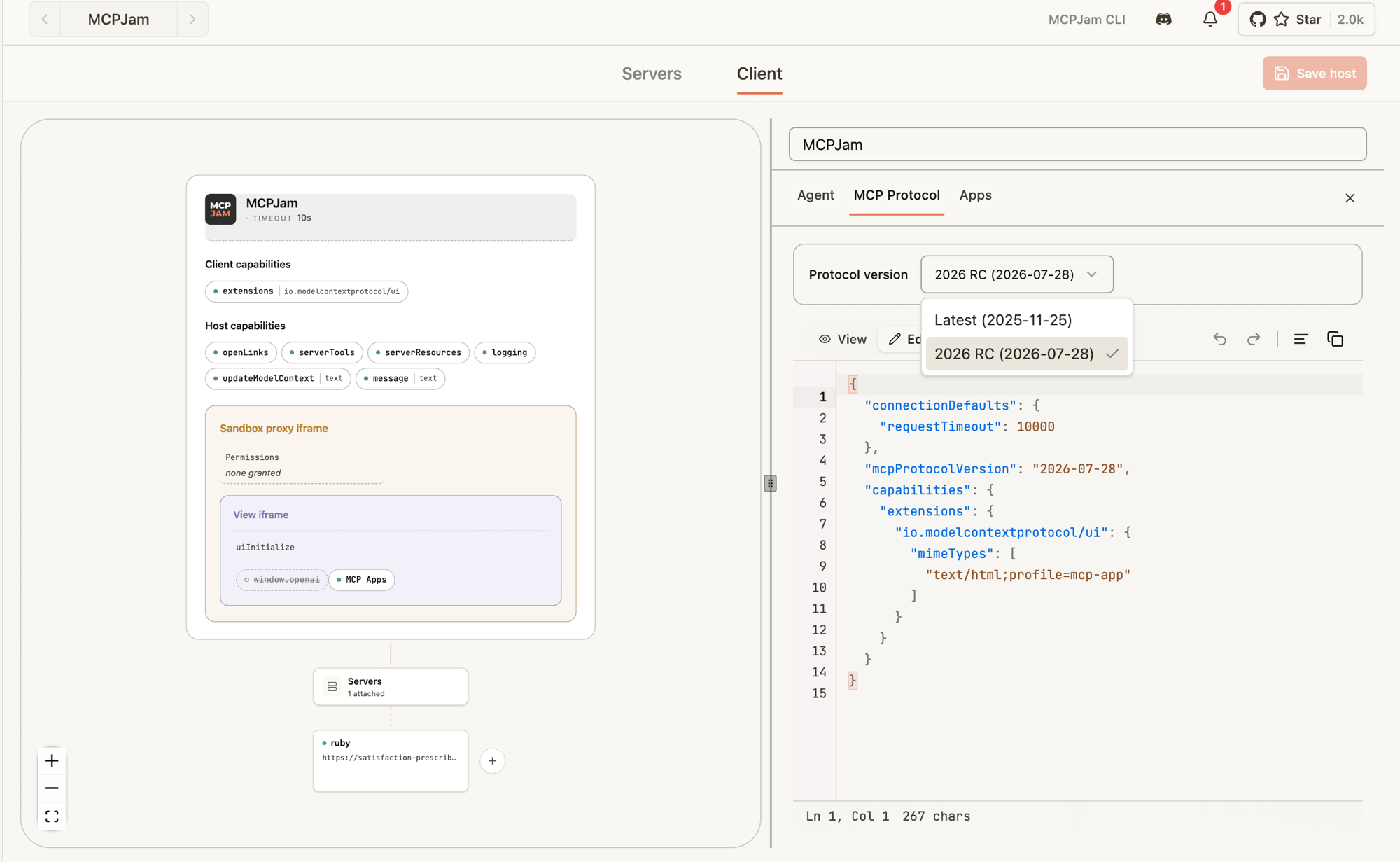 1. Open the **Clients** tab.
2. Pick the Client you want to edit (or create a new one).
3. Open the **MCP Protocol** tab.
4. In the **Protocol version** dropdown, pick **Latest** or **2026 RC (2026-07-28)**.
5. Save.
Every server attached to this Client now connects with that version unless it has its own per-server override.
## Overriding a single server
You can set the per-server protocol version either when adding a server or when editing an existing one.
### At add time (shared projects)
When adding a server to a shared project, the **Connection overrides** section of the Add Server modal includes a **Protocol version** picker. The 2026 RC option is only shown for HTTP servers.
1. Click **Add server** in the **Servers** tab.
2. Fill in the server details.
3. Expand **Connection overrides**.
4. Pick **Client default**, **Latest (2025-11-25)**, or **2026 RC (2026-07-28)** from the **Protocol version** dropdown.
5. Submit the form.
The pin is applied once the server is created and the connection is established.
### After adding (edit flow)
1. Go to the **Servers** tab.
2. Click the three dots on the server card → **Edit** (or open **View server info** → **Edit**).
3. Expand **Advanced settings**.
4. Find **Protocol version** and pick **Host default**, **Latest (2025-11-25)**, or **2026 RC (2026-07-28)**.
5. Save and reconnect the server.
The per-server override is the more specific signal — it wins over whatever the Client's MCP Protocol tab says.
## What changes when you pick the 2026 RC
If your server already speaks `2026-07-28`, you mostly won't notice. A few things to know when you're testing:
* **No `initialize` handshake.** The inspector connects, immediately fires `server/discover`, and uses the result to populate the server card's name, version, capabilities, and instructions.
* **Per-request metadata.** Every request the inspector sends carries `MCP-Protocol-Version: 2026-07-28` as an HTTP header and the same value inside `params._meta["io.modelcontextprotocol/protocolVersion"]`. `clientInfo` and `clientCapabilities` ride along on every request too.
* **No session IDs.** The inspector never sends an `mcp-session-id`. If your server returns one, the inspector discards it and surfaces a warning — your server isn't conforming to the stateless RC.
* **Cancellation is closing the stream.** For SSE responses, the inspector closes the response stream to cancel; your server should treat that as a cancel signal.
### What the inspector tells you
* If your server doesn't speak `2026-07-28`, `server/discover` returns `-32004 UnsupportedProtocolVersionError` and the connection fails with the supported-versions list visible in the Activity log.
* If your server is missing a capability the inspector needs for a request, you'll get `-32003 MissingRequiredClientCapability` back from your server — surface those in the Activity log to confirm they reach you.
* The **Activity** log (server card → **Activity**) is the source of truth — every request and response, success or error, lands there so you can verify headers and `_meta` content.
### Not yet supported in the RC client
The 2026 RC client is a **preview**. A handful of pieces from the SEP family aren't wired up yet — if you try them, the inspector throws a labeled error instead of silently no-op'ing:
* `subscriptions/listen` (long-lived notification stream)
* Server-initiated requests via MRTR / `InputRequiredResult` (sampling, elicitation, listRoots embedded in responses)
* Resumption tokens
* Backward-compat probes against pre-RC servers — if you point the RC client at an `initialize`-only server it will fail at `server/discover`, not fall back.
For everything else — `tools/list`, `tools/call`, `resources/*`, `prompts/*`, OAuth refresh, custom headers, progress notifications — the RC client behaves like the legacy one.
## Recommended testing flow
1. Build a Client called something like `2026 RC sandbox` with **MCP Protocol → 2026 RC** as the host default.
2. Attach the HTTP server you're upgrading.
3. Connect — confirm the server card shows the server info populated from `server/discover` (name, version, capabilities, instructions).
4. Run a `tools/list` and a `tools/call` from the **Tools** tab.
5. Watch the **Activity** log for the request `_meta` and the `MCP-Protocol-Version` header.
6. Try an unsupported version on a second test server to confirm your `-32004` error envelope looks right.
7. Once your server is happy on the RC, keep one Client on **Latest** so you can flip between versions without rewriting settings.
If you need to talk to a mix of servers on different versions in the same Client, use per-server overrides — the RC server stays pinned to `2026-07-28`, the rest fall back to Latest.
## Recommended reading
Background on the 2026-07-28 RC and the stateless direction the protocol is moving in:
* [MCP Is Growing Up](https://aaif.io/blog/mcp-is-growing-up/) — AAIF's overview of what the 2026-07-28 RC means for teams building agentic systems.
* [2026-07-28 release candidate announcement](https://blog.modelcontextprotocol.io/posts/2026-07-28-release-candidate/) — the official blog post walking through what the RC changes and why.
* [MCP specification (draft)](https://modelcontextprotocol.io/specification/draft) — the in-progress spec text the inspector's RC client targets.
1. Open the **Clients** tab.
2. Pick the Client you want to edit (or create a new one).
3. Open the **MCP Protocol** tab.
4. In the **Protocol version** dropdown, pick **Latest** or **2026 RC (2026-07-28)**.
5. Save.
Every server attached to this Client now connects with that version unless it has its own per-server override.
## Overriding a single server
You can set the per-server protocol version either when adding a server or when editing an existing one.
### At add time (shared projects)
When adding a server to a shared project, the **Connection overrides** section of the Add Server modal includes a **Protocol version** picker. The 2026 RC option is only shown for HTTP servers.
1. Click **Add server** in the **Servers** tab.
2. Fill in the server details.
3. Expand **Connection overrides**.
4. Pick **Client default**, **Latest (2025-11-25)**, or **2026 RC (2026-07-28)** from the **Protocol version** dropdown.
5. Submit the form.
The pin is applied once the server is created and the connection is established.
### After adding (edit flow)
1. Go to the **Servers** tab.
2. Click the three dots on the server card → **Edit** (or open **View server info** → **Edit**).
3. Expand **Advanced settings**.
4. Find **Protocol version** and pick **Host default**, **Latest (2025-11-25)**, or **2026 RC (2026-07-28)**.
5. Save and reconnect the server.
The per-server override is the more specific signal — it wins over whatever the Client's MCP Protocol tab says.
## What changes when you pick the 2026 RC
If your server already speaks `2026-07-28`, you mostly won't notice. A few things to know when you're testing:
* **No `initialize` handshake.** The inspector connects, immediately fires `server/discover`, and uses the result to populate the server card's name, version, capabilities, and instructions.
* **Per-request metadata.** Every request the inspector sends carries `MCP-Protocol-Version: 2026-07-28` as an HTTP header and the same value inside `params._meta["io.modelcontextprotocol/protocolVersion"]`. `clientInfo` and `clientCapabilities` ride along on every request too.
* **No session IDs.** The inspector never sends an `mcp-session-id`. If your server returns one, the inspector discards it and surfaces a warning — your server isn't conforming to the stateless RC.
* **Cancellation is closing the stream.** For SSE responses, the inspector closes the response stream to cancel; your server should treat that as a cancel signal.
### What the inspector tells you
* If your server doesn't speak `2026-07-28`, `server/discover` returns `-32004 UnsupportedProtocolVersionError` and the connection fails with the supported-versions list visible in the Activity log.
* If your server is missing a capability the inspector needs for a request, you'll get `-32003 MissingRequiredClientCapability` back from your server — surface those in the Activity log to confirm they reach you.
* The **Activity** log (server card → **Activity**) is the source of truth — every request and response, success or error, lands there so you can verify headers and `_meta` content.
### Not yet supported in the RC client
The 2026 RC client is a **preview**. A handful of pieces from the SEP family aren't wired up yet — if you try them, the inspector throws a labeled error instead of silently no-op'ing:
* `subscriptions/listen` (long-lived notification stream)
* Server-initiated requests via MRTR / `InputRequiredResult` (sampling, elicitation, listRoots embedded in responses)
* Resumption tokens
* Backward-compat probes against pre-RC servers — if you point the RC client at an `initialize`-only server it will fail at `server/discover`, not fall back.
For everything else — `tools/list`, `tools/call`, `resources/*`, `prompts/*`, OAuth refresh, custom headers, progress notifications — the RC client behaves like the legacy one.
## Recommended testing flow
1. Build a Client called something like `2026 RC sandbox` with **MCP Protocol → 2026 RC** as the host default.
2. Attach the HTTP server you're upgrading.
3. Connect — confirm the server card shows the server info populated from `server/discover` (name, version, capabilities, instructions).
4. Run a `tools/list` and a `tools/call` from the **Tools** tab.
5. Watch the **Activity** log for the request `_meta` and the `MCP-Protocol-Version` header.
6. Try an unsupported version on a second test server to confirm your `-32004` error envelope looks right.
7. Once your server is happy on the RC, keep one Client on **Latest** so you can flip between versions without rewriting settings.
If you need to talk to a mix of servers on different versions in the same Client, use per-server overrides — the RC server stays pinned to `2026-07-28`, the rest fall back to Latest.
## Recommended reading
Background on the 2026-07-28 RC and the stateless direction the protocol is moving in:
* [MCP Is Growing Up](https://aaif.io/blog/mcp-is-growing-up/) — AAIF's overview of what the 2026-07-28 RC means for teams building agentic systems.
* [2026-07-28 release candidate announcement](https://blog.modelcontextprotocol.io/posts/2026-07-28-release-candidate/) — the official blog post walking through what the RC changes and why.
* [MCP specification (draft)](https://modelcontextprotocol.io/specification/draft) — the in-progress spec text the inspector's RC client targets.